
Instantly verify your personal SIM ownership details through our secure SIM checking system, CNIC validation platform, and live number status service with complete authorization, privacy protection, and trusted real-time record access.
Get Accurate Phone Data in Pakistan
Check your SIM details legally in Pakistan with Sim Owner Details, a secure service that provides access to personal SIM data and public information with strong privacy control.
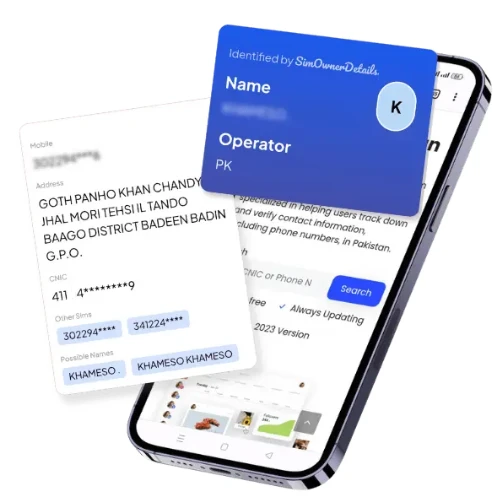
Easy-to-use tools crafted just for you
Information that normally takes time from official sources in Pakistan can now be accessed faster through a secure system, allowing you to legally verify SIM registration and CNIC details anytime.
1.
Pak SIM Data
Secure your peace by recording doubtful callers and reporting them using authorized legal methods.

2.
Live Tracker
Reliable Live Tracker features support accurate updates, smooth navigation, and protected monitoring for daily activities.
3.
CNIC Information
CNIC information should only support lawful reporting procedures, not personal location monitoring
4.
DLIMS Punjab
Verify full Punjab driving license details easily with the advanced and dependable DLIMS information system.
5.
DLIMS Sindh
Verify authentic Sindh driving license details instantly using the advanced and dependable DLIMS verification system.
6.
DLIMS KPK
Trusted DLIMS KPK systems provide secure licensing support and smooth verification services across all districts.
7.
DLIMS Balochistan
DLIMS Balochistan provides secure driving license verification services with accurate records and efficient online accessibility.
8.
DLIMS Islamabad
DLIMS Islamabad supports accurate driving license services through secure systems and efficient digital verification processes nationwide.
Get Your Latest Energy Bill Instantly Online.
Our platform allows users across Pakistan to conveniently check their electricity bills online by selecting their respective power company from a list and instantly viewing monthly bill details.





7.
PESCO BILL
Our platform allows you to safely retrieve your PESCO electricity bill anytime.

7.
TESCO BILL
Get instant access to your TESCO electricity statement through our web service.


How to Check SIM Owner Details in Pakistan: The Full Official Walkthrough (2026)
If you’ve searched “sim owner details,” you’re almost certainly after one of two completely different pieces of information: how many mobile connections currently sit against your own CNIC, or the identity of whoever owns a number that keeps calling you. Pakistan’s telecom regulator has built a genuine, working solution for the first of those. For the second one, no website, app, or “database” can legally hand you an answer — not one that actually exists, anyway. This guide walks through exactly what the official channels can and can’t tell you, how to run the check in roughly two minutes, what the relevant law actually says, and everything that shifted for SIM holders across 2026. It also clears up the four terms people constantly confuse — SIM, number, CNIC, and IMEI — and covers the scenarios that generate the most searches: shared household connections, getting your very first SIM, years spent overseas, and a lost or stolen handset.
Based on PTA guidance and the Pakistan Code No shortcuts, no third-party lookup tool Refreshed to reflect 2026 rules
The short version: text your 13-digit CNIC number — no dashes — to 668, or enter it at cnic.sims.pk instead. Either path hands back a tally of SIMs registered under that CNIC, sorted by operator. What you won’t get, under any circumstances, is a name, a phone number, or an activation date — not for your own CNIC and definitely not for someone else’s. Under PTA’s published rules, an individual can hold up to eight SIMs at once: five for voice service and three reserved for data-only connections.
On this page
- What “SIM owner details” really means
- SIM vs. number vs. CNIC vs. IMEI
- The two official self-check routes
- Making sense of your results
- Just picked up or ported a SIM? Confirm it
- Common scenarios, sorted out
- The legal cap on SIMs per CNIC
- Lookup myths, debunked
- Why nobody can name a stranger from their number
- Operator support lines and status shortcodes
- What actually changed in 2026
- Disowning a SIM, blocking it, and filing a report
- Your protections under PECA 2016
- A quick lookup table for common goals
- مختصر اردو رہنمائی
- Frequently asked questions
- Glossary of terms
- Sources and editorial review
What “SIM Owner Details” Really Means
People type this phrase in looking for two fundamentally unrelated answers, and conflating them is where most of the internet’s bad advice on this subject originates.
Question one: “How many SIMs does the system show against my name?” This is entirely above-board — it’s your own information, and PTA (the Pakistan Telecommunication Authority) purpose-built a free, public self-service tool to answer precisely this. No sign-up, no app download, nothing beyond the regulator’s own standard charges.
Question two: “Who’s behind this number that keeps ringing me?” That’s a different animal altogether, and there is no legitimate Pakistani channel that will identify a stranger for you. This isn’t a market gap some clever app will eventually fill — it’s a hard legal line. Section 16 of the Prevention of Electronic Crimes Act 2016 (PECA) criminalizes disclosing someone else’s identity information without their say-so, carrying penalties of up to three years behind bars and fines reaching Rs 5 million. Any working “type a number, get a name” service would necessarily be committing that exact offence.
Every part of this guide keeps that boundary intact: what you’re allowed to check about yourself, which official route to use, and what your actual options are when what you want is identifying an unknown caller or dealing with a SIM someone else abused.
It’s worth being upfront about why this distinction gets blurred so often in the first place. Plenty of people arrive at this topic after a bad experience — a scam call, a harassing text, a suspicious message claiming to be from a bank — and their instinct is to reach for the same kind of tool that answers “how many SIMs are on my CNIC,” assuming a mirror-image version must exist for other people’s numbers too. It doesn’t, and understanding why up front will save you from wasting time on apps and websites that were never going to deliver what they promised.
SIM, Number, CNIC and IMEI — Untangled
A huge chunk of “sim owner details” searches are actually four separate questions wearing one trench coat. Sorting them out first will save you a lot of time, because each is handled by an entirely different system for an entirely different purpose — and none of the four will answer a question meant for one of the others.
SIM — the physical chip (or its digital eSIM equivalent) an operator issues, tied to one CNIC at any given moment. This whole guide is centered on checking SIM registration.
Mobile number — the dialable digits themselves. Thanks to Mobile Number Portability (MNP), a number can now hop between operators while staying identical, which means a number isn’t forever welded to a single SIM, carrier, or even owner across its lifetime.
CNIC — your Computerised National Identity Card number, assigned by NADRA. Every SIM registered anywhere in Pakistan gets matched against a CNIC — which is exactly why every official tool discussed here asks for a CNIC and flatly refuses to accept a phone number instead.
IMEI — a serial number that belongs to the handset itself, entirely unconnected to whichever SIM happens to be inside it or whoever’s using it. PTA’s device-compliance tracking — the system that blocks smuggled or unregistered phones — runs through a separate platform called DIRBS, unrelated to SIM ownership.
If your real question is whether a particular handset is legitimately cleared to work on Pakistani networks, rather than who’s holding the SIM currently sitting inside it, you’re asking a DIRBS/IMEI question — its own official process, entirely separate from anything CNIC-based covered here. Dialling *#06# on the phone itself is the usual first move to surface its IMEI before running that check.
Keeping these four terms straight matters beyond just picking the right tool. A lot of confused, worried searches — “why does my number show a different name,” “is my SIM linked to someone else,” “does my phone’s IMEI reveal my identity” — trace back to someone assuming these four things are interchangeable when they’re really four independent records, each maintained by a different part of the system, and each answerable only through its own dedicated channel.
The Two Official Self-Check Routes
PTA operates a single backend for this purpose — formally the SIM Information System, running since October 2009 — and offers two front-end doors into it: an SMS shortcode and a website. Both return identical information in the same layout. Pick whichever suits the moment.
Before starting, gather: your own 13-digit CNIC (printed on the card’s front, entered with no dashes); either a SIM with enough credit for one text message or any browser-capable device; and roughly two minutes of spare time. Neither official channel will ever request a password, an OTP, or card details — if something claiming to be part of this process asks for any of that, it isn’t PTA’s system, no matter how convincing it looks.
Route A — Text 668
- Open the messaging app on any working connection.
- Type your CNIC as 13 digits — no dashes, no gaps.
- Send it to 668.
- A reply arrives listing every operator alongside how many SIMs are registered to that CNIC on that network.
Two caveats worth flagging. First, ordinary SMS rates may apply when texting 668 — PTA hasn’t published a flat fee, so don’t assume “government-run” means “free.” Second, the system checks whichever CNIC you actually type in, regardless of whose SIM sent the message. That’s a responsibility, not a workaround: querying a CNIC that isn’t yours, without that person’s go-ahead, is exactly the behavior PECA Section 16 was written to punish.
Route B — cnic.sims.pk
The identical backend is reachable through a web form at cnic.sims.pk. Enter your CNIC (there’s a “Foreign ID” field for foreign nationals holding a Pakistani connection), hit submit, and you’ll get the same per-operator breakdown. No login, account, or install required.
What shows up — and what doesn’t
You’ll see:
- A per-operator count of SIMs registered to the CNIC entered
- A voice/data-only split, where the system provides one
- A clean “0” for any operator with nothing registered
You won’t see:
- Names, phone numbers, or ICCID/serial numbers
- When any particular SIM was activated
- Anything belonging to a CNIC other than the one you personally submitted
If any site, app, or “agent” claims to hand you more than a bare count — a name, a number, an address, a photo — it has nothing to do with PTA’s actual system. Treat it exactly like you’d treat a fake bank-login page: built to harvest your data, not deliver anyone else’s.
A useful habit here is to check the URL and the request itself before typing anything in. PTA’s own systems will only ever ask for a CNIC (or, for the 667 check, nothing at all beyond sending a text from the SIM itself). Any form that asks for your CNIC alongside a password, an email address, a photo of your ID card, or a one-time code sent to your phone has stepped well outside what a legitimate SIM-count lookup needs, and is worth closing immediately rather than completing.
Making Sense of Your Results
Both routes hand back the same basic shape: a short list, one line per operator, each with a number attached — zeros included. Seeing “0” beside a carrier’s name is a normal, correct outcome, not an error — it just means that operator has nothing registered to that CNIC. The web tool timestamps its result under the system’s formal label, “PMD SIM Information System,” and never asks you to sign in first.
If the count seems higher than expected
There’s usually a boring explanation before there’s an alarming one. Pakistani households routinely register a spouse’s, child’s, or parent’s SIM under a single family member’s CNIC purely for convenience — so an inflated count often just reflects connections other people in your home are using, entirely with your blessing. Forgotten old SIMs — from a previous employer, a short-term plan, or a retired device — are the next likeliest culprit. Only after ruling both of those out is it worth treating a mystery SIM as possible misuse; the reporting section further down covers what comes next.
If everything reads zero
That’s entirely ordinary if the phone you use every day is carrying a SIM registered to somebody else’s CNIC — a parent’s, a spouse’s, or an employer’s, say. A blank result across every carrier simply means no SIM nationwide currently sits against your own CNIC — it doesn’t mean the lookup failed or your record’s broken.
How long you’ll wait
The website answers the instant you hit submit. The SMS route depends on your own network’s traffic at that moment, though a reply typically lands within a few minutes. If nothing shows up after a reasonable stretch, resending once is the normal next step before assuming something’s gone wrong.
If you’d rather not rely on a screenshot from a friend
It’s common for people to see a relative’s or coworker’s result and assume the format or wording will be identical for their own CNIC — but small differences (an extra operator listed, a slightly different label for data-only connections) are normal and depend on what’s actually registered to that specific CNIC, not on how the system happens to be behaving that day. Running the check yourself, rather than comparing notes secondhand, is always the more reliable approach.
Just Got or Ported a SIM? Confirm It’s Actually Yours
The 668/cnic.sims.pk check tells you “how many” — not “is this particular SIM genuinely registered to me.” For that specific question, PTA runs a separate check tied to the sending device.
From the new SIM itself — and only from that SIM — send the text MNP to 667. The reply reads back that exact connection’s registration file: registered name, the CNIC attached to it, the number, and its SIM/ICCID identifier.
Run this the same day you pick up a new connection from a franchise, or right after a porting request finishes. It matters because 667 is locked to the sending SIM, unlike 668, which will look up whatever CNIC you feed it regardless of which phone sent the text. If the returned name or CNIC isn’t yours, don’t activate or keep using that SIM — return to wherever you got it, and escalate through the reporting channels below if the outlet won’t cooperate.
Common Scenarios, Sorted Out
You share a family plan
It’s completely normal in Pakistani households for one person’s CNIC to carry SIMs that other relatives actually use daily — a parent registering a line for a school-age kid, or a wife using a connection registered under her husband’s CNIC as household account-holder. If your check turns up SIMs you recognize as belonging to family, there’s nothing to fix — the record is accurate; it’s just shared on purpose. A real problem only starts once a SIM shows up that literally nobody in the household recognizes.
You’re getting your very first SIM
Before leaving the franchise counter, run the 667 check straight from the new SIM while you’re still standing there. First-time buyers, in our experience, are the group most likely to end up with a misregistered connection — occasionally under the dealer’s own CNIC by accident, or under whichever relative tagged along to help — mostly because it’s the first time anyone in the room is actually watching the registration step closely.
You’ve lived abroad and haven’t checked in years
Overseas Pakistanis make up a substantial share of everyone using PTA’s SIM Information System — the tool was designed with exactly this group in mind. If you haven’t checked your CNIC’s record in years, running it now costs nothing more than one SMS charge, and it’s the only dependable way to find out whether a connection was registered under your name while you were out of the country. If you do turn up an unrecognized SIM, filing the first step of a disowning complaint through complaint.pta.gov.pk doesn’t require a Pakistani SIM to submit it.
Your phone was lost or stolen
Losing a handset is a blocking problem first — call your operator’s helpline right away and get that specific SIM blocked — and a CNIC-record problem second. Once the block is done, it’s worth rerunning the 668 or cnic.sims.pk check a few weeks afterward, specifically to make sure nobody exploited the gap to fraudulently register a fresh SIM against your CNIC at some outlet.
You’re helping an older relative who’s uneasy with texting
The cnic.sims.pk web form is usually simpler to walk someone through in person or on a video call — there’s no code to type correctly and no reply to decode, just a CNIC in a plain form field. Where SMS is the only option available, write out the exact message beforehand (13 digits, no dashes, sent to 668) so a typo doesn’t accidentally return somebody else’s record.
You’re puzzled by a company-issued SIM
SIMs issued through an employer’s corporate account typically register under the company’s own paperwork rather than your personal CNIC — which is exactly why a work phone’s SIM might not turn up at all when you check your own record. That’s expected, not a red flag. If you’re changing jobs, ask HR or the employer’s telecom contact whether the number moves to your personal CNIC or gets shut off on your last day, since corporate SIM handling differs from employer to employer and isn’t governed by a single fixed national rule.
You’ve just gotten married and are consolidating household numbers
Marriage is one of the more common reasons people run this check for the first time. Newly combined households often want to know exactly what’s registered where before deciding whether to keep separate CNIC-registered lines or move everything under one person’s name for simplicity. There’s no requirement to consolidate — plenty of households keep every adult’s SIM registered to that same adult indefinitely — but if you do decide to transfer a line, that’s a standard ownership-transfer request handled directly through the operator’s outlet, not something the 668 or cnic.sims.pk check itself performs.
You inherited a phone or number from a family member who passed away
This is an emotionally difficult version of the same question, and it comes up more often than you’d expect. A SIM registered to someone who has passed away doesn’t automatically transfer or deactivate — it typically needs to be handled directly with the operator, usually with a death certificate and the relevant family documentation, before it can be reassigned or formally closed. Running the 668 check against the deceased relative’s CNIC can still confirm what’s currently on record, which is often the first practical step before approaching the operator to sort out next steps.
How Many SIMs Are You Legally Allowed to Hold?
PTA’s published FAQ caps personal use at eight SIMs per CNIC — up to five on voice plans, three on data-only plans. That’s the number to trust. Because other figures circulate online, it’s worth being clear about where eight comes from and where the confusion tends to start.
You’ll sometimes see this cap credited to a November 2015 Supreme Court of Pakistan ruling. We went looking for a primary, citable copy of that judgment specifically to verify this page, and couldn’t locate one — period news coverage gives inconsistent dates and details. Rather than repeat an attribution we can’t confirm, this guide states the limit exactly the way PTA itself frames it: as regulatory policy from PTA’s FAQ, not as case law.
Claims circulating online about the SIM cap, checked against PTA’s own FAQ
| Claim making the rounds | Status | What PTA’s FAQ actually says |
|---|---|---|
| The cap dropped from 8 to 6 in December 2025 | No PTA source located | PTA’s FAQ still lists eight total (five voice + three data) as of this review |
| The total limit is just 5, no exceptions | No PTA source located | Five applies only to voice connections; three additional data-only SIMs are separately allowed |
| Corporate and M2M SIMs count against your personal cap | Unconfirmed | PTA’s FAQ addresses personal-use SIMs only; there’s no clear published rule folding corporate or M2M allocations into an individual’s cap |
| The cap is 8 per CNIC (5 voice + 3 data) | Matches PTA’s FAQ | This is the figure to rely on |
Lookup Myths, Debunked
Searching “sim owner details” surfaces a long tail of apps, shortcodes, and viral WhatsApp forwards promising far more than the real system delivers. Most of these tools follow a predictable pattern: they look convincing enough at first glance, they ask you to enter information before showing you anything, and the actual output — when there is one — turns out to be generic, wrong, or simply never loads. None of the following hold up under any scrutiny.
Claims you’ll run into vs. what’s actually true
| The claim | The reality |
|---|---|
| “This app reveals the name and address behind any number” | No genuine Pakistani app or site does this for a stranger’s number. Whatever claims otherwise is either non-functional, pulling unrelated scraped data, or a front end built to collect your CNIC and number — not hand over someone else’s. |
| “A code like *336# will reveal the other person’s identity” | Codes in this family check the biometric-verification status of the SIM you’re dialling from — a simple yes/no on whether your own registration is verified — not a name-lookup for anyone else’s number. |
| “Caller-ID apps show the government-registered owner” | Those names come from other app users typing in whatever they guessed for that number at some point. That’s crowdsourced guesswork, not a PTA record, and it’s wrong more often than people assume. |
| “‘Operation Clean Sweep 3.0’ will block unverified SIMs within 72 hours” | This exact claim and timeframe trace back to no PTA announcement whatsoever. It’s a recurring bit of viral misinformation. PTA’s actual, historical pattern for handling unauthorised SIMs runs on a longer cycle — warning, then temporary suspension, then a block — never a same-day cutoff. |
| “Checking a relative’s SIM count doesn’t need their consent” | Not quite. Running the lookup itself is harmless, but acting on someone else’s CNIC without them knowing — or sharing what you find without good reason — edges straight into what PECA Section 16 was written to stop. |
| “A paid or ‘premium’ lookup app unlocks real names” | No paid tier changes the underlying legal reality. If a free app can’t legitimately show a stranger’s name, a paid upgrade doesn’t grant access to PTA’s protected records — it just charges you for the same empty promise. |
Why No Site Can Name a Stranger From a Phone Number
This deserves spelling out directly, because wanting the answer is completely reasonable even though the service simply doesn’t exist. If an unfamiliar number keeps calling or texting you, curiosity about who’s behind it makes total sense.
Here’s the legal reality: information tied to a CNIC counts as personal identity information. Under PECA Section 16, obtaining or disclosing someone’s identity information without their authorization is a criminal offence — up to three years in prison, a fine reaching Rs 5 million, or both. A public “type a number, get a name” tool would require PTA or an operator to release exactly this kind of protected data at scale, and neither PTA’s portal nor any operator’s customer service will do that for anyone, short of a lawful investigation.
So what’s your actual move when an unknown number is a real problem?
- Harassing or threatening calls/messages: block the number on your device, save the messages as evidence, and file a complaint with the National Cyber Crime Investigation Agency (NCCIA) through its round-the-clock helpline, 1799.
- Suspected fraud (someone requesting OTPs, claiming to represent your bank, PTA, or NADRA): never hand over a code, CNIC digits, or any personal detail on the call. Report it via PTA’s complaint portal at complaint.pta.gov.pk or the PTA CMS app.
- A number that keeps calling with nothing criminal happening yet: most phones let you block or silence unlisted numbers by default; there’s no official identification path beyond that for a private individual’s number.
Wanting a stranger’s name attached to their number will likely never get a public self-service answer in Pakistan, for the same reason your own record isn’t searchable by strangers either. The protection cuts both ways.
It’s also worth remembering that even legitimate businesses and individuals sometimes call from numbers that look unfamiliar simply because they’re using a new line, a call-center system, or a number that hasn’t been saved in your contacts yet — not every unrecognized call is suspicious. Before assuming the worst, a quick search of the number itself (without entering it into any “lookup” tool) sometimes surfaces public information the caller has voluntarily shared, such as a business listing. That’s a meaningfully different thing from a CNIC-based identity lookup, and it doesn’t carry the same legal restrictions, precisely because it relies on information the person or business chose to make public.
Operator Support Lines and Status Shortcodes
Every mobile operator runs its own customer-service line for SIM-specific issues — replacements, blocking a lost SIM, disputing a registration. None of these lines, or the shortcodes below, perform a “who owns this number” search; the codes that do exist only check the status of the SIM dialling in, nothing further.
Operator customer-care numbers (for issues with your own SIM)
| Operator | Helpline |
|---|---|
| Jazz | 111 (dial from a Jazz number) |
| Zong | 310 (from a Zong number); UAN 051-111-222-111 |
| Telenor | 345 (from a Telenor number) |
| Ufone | 333 (from a Ufone number) |
The Special Communications Organisation (SCO) serves Azad Jammu & Kashmir and Gilgit-Baltistan as that region’s dedicated carrier. SCO connections sit on the same nationwide SIM Information System as the four operators above, so both the 668 and cnic.sims.pk checks work identically for SCO-registered SIMs.
Biometric-verification status codes
Shortcodes such as 6001, 7911, and 7751, along with the *336# menu, let you check whether the SIM you’re dialling from has completed the Multi Random Finger Biometric Verification System (MBVS) re-verification process. They report a status — verified or not — for your own connection only, never an identity for any other number. Treat any claim that these codes “reveal” a caller’s name with exactly the skepticism the myths table above suggests.
If you’re trying to guess an operator from a number’s leading digits, keep in mind that those prefixes reflect whichever network originally issued the SIM. Once a number has been ported through Mobile Number Portability (MNP), the prefix stops reliably telling you who currently serves it.
This matters for customer service too — once a number has switched carriers, the new operator is the one actually equipped to help with that SIM, even though its leading digits might still visually point to the original network. When you’re unsure which operator currently holds a number, checking that SIM’s own balance and package menu on the handset itself beats guessing from the prefix, since the on-device menu always reflects the current carrier.
What Actually Changed for SIM Owners in 2026
Several concrete, dated developments landed across 2026 — worth knowing before you rely on anything older you might have already seen elsewhere.
- PTCL–Telenor merger, effective July 1, 2026. Expect gradual shifts in Telenor’s branding and customer-service integration over the months that follow; the merger itself doesn’t touch existing SIMs or numbers.
- eSIM transfer fee capped, effective August 17, 2026. Moving an eSIM profile onto a new device now costs no more than Rs 1,500, and the first ten transfers on any given eSIM are free. That’s a lifetime allowance of ten free transfers per eSIM — not a yearly reset.
- Facial-recognition verification — proposed, not active. As of August 2026, NADRA and PTA are in publicly reported, ongoing talks about layering facial-recognition verification (through NADRA’s Pak ID app) onto SIM-related checks. Nothing has been implemented as a requirement yet. Treat any claim that facial verification is now mandatory for SIM registration as premature.
- Enforcement figures, corrected. NADRA’s statement from June 17, 2025 about roughly 4.9 million flagged records described the scope of a phased CNIC-review exercise — it was counting CNICs, not disconnected SIMs. The actual enforcement total reported for January–July 2026 came to approximately 1.84 million illegal SIMs disconnected: about 903,000 tied to deceased persons’ CNICs, roughly 244,000 linked to invalid, expired, or cancelled CNICs, and around 691,000 for other verification failures. If you see the 4.9 million figure being quoted as “SIMs blocked in 2026,” that’s a misapplication of the original statement.
- Operators face penalties too. On August 31, 2026, PTA fined Jazz Rs 38.9 million over corporate-SIM verification failures involving roughly 400 unauthorised connections — a reminder that verification duties, and the consequences of failing them, sit with operators rather than ordinary subscribers.
- Active SIM base. PTA reported around 208 million active SIMs nationwide as of June 2026 — useful scale for putting these enforcement figures in context.
Taken as a whole, the 2026 changes lean in a fairly consistent direction: tighter verification on the operator side, clearer and cheaper processes for ordinary subscribers (the capped eSIM transfer fee and the toll-free PTA complaint line both fall into this bucket), and continued caution around anything that isn’t yet formally in force, like facial-recognition verification. If you’re reading older articles or forwarded messages from before mid-2026, it’s worth re-checking any specific figure or rule against PTA’s current published material rather than assuming it still holds, since several of the details above directly corrected earlier, looser reporting.
Something Off? Disowning, Blocking and Reporting
A SIM is registered to you, but you never took it out
PTA lets you disown a SIM you never knowingly registered. If that SIM has been active under six months, a Rs 200 processing fee applies — a rule in effect since January 1, 2024. Where a SIM is shown to have been issued fraudulently under your name, that fee gets waived once for the disowning request. You may also run across mention of a “365-day rule” alongside disowning — this refers to a waiting or eligibility window tied to the disowning process itself, not a separate rule blocking you from transferring or re-registering a number afterward; we haven’t been able to confirm this specific detail on a primary PTA page, so treat it as secondary and not fully verified.
Filing a SIM-related complaint with PTA
- Online: complaint.pta.gov.pk
- Mobile app: the official PTA CMS app
- Phone: 0800-55055 — free when dialled from a mobile handset, as of February 10, 2026
Reporting cybercrime, harassment, or identity misuse
The National Cyber Crime Investigation Agency (NCCIA) — established under PECA, having absorbed this mandate from the former FIA Cyber Crime Wing, and running its helpline since June 3, 2025 — operates a 24-hour line: 1799. This is your first call for threats, blackmail, harassment, or anyone using your CNIC or identity without permission, including to register a SIM.
Your Protections Under PECA 2016
The Prevention of Electronic Crimes Act 2016 is the law most directly relevant to SIM and identity misuse. Two sections matter most here:
Section 16 — Unauthorised use of identity information
Obtaining, selling, transmitting, or using someone else’s identity information — which covers CNIC-linked records — without their consent carries penalties of up to three years’ imprisonment, a fine reaching Rs 5 million, or both.
Section 17 — Unauthorised issuance of a SIM card
Issuing, or knowingly helping issue, a SIM registered against someone else’s CNIC without their consent is a separate offence, punishable by up to three years’ imprisonment, a fine of up to Rs 500,000, or both.
Two practical takeaways fall directly out of this. First, running a SIM-count check (668 or cnic.sims.pk) on a CNIC that isn’t yours, without that person’s consent, can itself fall under Section 16 — which is why this guide keeps repeating that these checks are for your own CNIC and nobody else’s. Second, if you discover a SIM registered under your name that you never authorised, whoever obtained it is very possibly exposed under Section 17 — worth mentioning when you file with PTA or NCCIA.
It’s also worth understanding how these two sections tend to work together in practice, rather than treating them as two unrelated clauses. A single incident of SIM fraud — someone registering a connection using a stolen or borrowed CNIC — frequently triggers both provisions at once: Section 17 covers the unauthorised issuing of the SIM itself, while Section 16 covers the broader misuse of the underlying identity information that made the fraud possible in the first place. When you’re filing a complaint, mentioning both sections, or letting the investigating officer identify which applies, tends to produce a more complete record than citing just one.
None of this is intended as formal legal advice, and PECA’s practical enforcement — how quickly a complaint moves, what evidence is expected, how a specific case gets classified — can vary by circumstance. If you’re dealing with a serious case of identity or SIM misuse, treating this guide as a starting point rather than a substitute for direct engagement with NCCIA or a lawyer is the safer approach.
Quick Lookup Table for Common Goals
Everything above, condensed by what you’re actually trying to accomplish right now.
| What you want to do | Do this |
|---|---|
| Check how many SIMs sit on your own CNIC | Text your 13-digit CNIC (no dashes) to 668, or use cnic.sims.pk |
| Confirm a new SIM is genuinely registered to you | From that SIM, text “MNP” to 667 |
| Find out who owns a number that keeps calling you | No official option — block the number and report harassment to NCCIA on 1799 |
| Remove a SIM you never registered | File a disowning request with PTA — Rs 200 fee if under six months old, waived once for proven fraud |
| Report someone misusing your CNIC to get a SIM | complaint.pta.gov.pk, the PTA CMS app, or 0800-55055 — plus NCCIA on 1799 |
| Check whether a handset (not a SIM) is legitimate for use in Pakistan | A separate DIRBS/IMEI question — check directly through PTA’s device-registration system |
Taken together, these scenarios cover nearly everything “sim owner details” gets searched for across Pakistan. The thread running through all of it stays the same: PTA’s own channels answer questions about your own CNIC fast, for nothing beyond a standard SMS charge, while no channel — official or otherwise — will ever answer questions about someone else’s number. It’s worth bookmarking this page if you expect to need it again; SIM rules in Pakistan have shifted more than once over the last couple of years, and the surest way to end up misinformed is trusting an old screenshot or forwarded message instead of checking the current rule directly.
مختصر اردو رہنمائی
اگر آپ یہ جاننا چاہتے ہیں کہ آپ کے شناختی کارڈ پر کتنی سمیں رجسٹرڈ ہیں، تو اپنا 13 ہندسوں پر مشتمل کمپیوٹرائزڈ شناختی کارڈ نمبر — بغیر ڈیش کے — 668 پر ایس ایم ایس کریں، یا cnic.sims.pk ویب سائٹ پر درج کریں۔ جواب میں ہر موبائل کمپنی کے مطابق سموں کی تعداد ملے گی، نہ کہ نام یا نمبر۔
یاد رکھیں: یہ سہولت صرف اپنے شناختی کارڈ کے لیے استعمال کریں۔ کسی اور کے شناختی کارڈ پر یہ چیک اس کی اجازت کے بغیر کرنا پاکستان کے سائبر کرائم قانون (پیکا) کی دفعہ 16 کے تحت جرم شمار ہوتا ہے۔
پی ٹی اے کے مطابق ایک شناختی کارڈ پر زیادہ سے زیادہ آٹھ سمیں رکھی جا سکتی ہیں — پانچ کالنگ کے لیے اور تین صرف ڈیٹا کے لیے۔ نئی سم خریدنے کے بعد اسی سم سے “MNP” لکھ کر 667 پر بھیجیں تاکہ معلوم ہو کہ وہ سم واقعی آپ کے نام پر رجسٹرڈ ہوئی ہے۔
اگر کوئی نامعلوم نمبر بار بار پریشان کرے تو اسے بلاک کریں اور نیشنل سائبر کرائم انویسٹی گیشن ایجنسی کی ہیلپ لائن 1799 پر شکایت درج کروائیں۔ کوئی بھی ویب سائٹ یا ایپ کسی اجنبی نمبر کا اصل نام قانونی طور پر ظاہر نہیں کر سکتی — یہی قانون آپ کے اپنے ریکارڈ کی حفاظت بھی کرتا ہے۔
یہ بھی ذہن نشین رکھیں کہ سم، موبائل نمبر، شناختی کارڈ اور آئی ایم ای آئی (IMEI) چار الگ چیزیں ہیں۔ سم کا تعلق آپ کے شناختی کارڈ سے ہوتا ہے، جبکہ آئی ایم ای آئی محض ہینڈ سیٹ کا نمبر ہے — اس کا سم کے مالک سے کوئی براہ راست تعلق نہیں۔
پاکستانی گھرانوں میں اکثر ایک ہی شناختی کارڈ پر خاندان کے کئی افراد کی سمیں رجسٹرڈ ہوتی ہیں — مثلاً شوہر کے کارڈ پر بیوی یا بچوں کی سم۔ اگر نتیجے میں ایسی سمیں نظر آئیں جنہیں گھر والے خود استعمال کر رہے ہیں تو کوئی مسئلہ نہیں۔ پریشانی صرف تب ہونی چاہیے جب کوئی سم ایسی سامنے آئے جسے گھر میں کوئی نہ پہچانے۔
Glossary
| Term | Meaning |
|---|---|
| CNIC | Computerised National Identity Card — Pakistan’s 13-digit national ID number, issued by NADRA. |
| SIM Information System | PTA’s official backend (running since October 2009) that reports SIM counts against a CNIC, reachable via 668 (SMS) and cnic.sims.pk (web). |
| MNP | Mobile Number Portability — moving a number between operators while keeping it unchanged; also the keyword used in the 667 SMS registration check. |
| PECA | Prevention of Electronic Crimes Act, 2016 — Pakistan’s core cybercrime law, covering identity misuse, electronic fraud, and related offences. |
| NCCIA | National Cyber Crime Investigation Agency — the federal body handling cybercrime complaints under PECA, reachable via the 1799 helpline. |
| Biometric verification (MBVS) | PTA’s Multi Random Finger Biometric Verification System, confirming a SIM’s registration against NADRA’s fingerprint records. |
| Disowning a SIM | PTA’s formal process for removing an unrecognised SIM from your CNIC record. |
| eSIM | A digital SIM profile built into supported devices, transferable between devices subject to PTA’s transfer-fee rules. |
| IMEI | A unique serial number identifying a physical handset, unrelated to whoever owns the SIM inside it. |
| DIRBS | PTA’s Device Identification, Registration and Blocking System — the separate process checking whether a handset (by IMEI) is legitimately cleared for use in Pakistan. |
| MBVS | Multi Random Finger Biometric Verification System — PTA’s formal name for the fingerprint re-verification process behind the operator status codes covered here. |
Sources and Editorial Review
This guide is built on the Pakistan Telecommunication Authority’s published FAQs and press releases, the text of the Prevention of Electronic Crimes Act 2016 as consolidated in the Pakistan Code, and dated 2025–2026 news coverage of regulatory changes — NADRA’s CNIC-review statement, the operator merger, and the eSIM-fee notifications among them. Any figure we couldn’t trace back to one of these sources is flagged in the text as unverified rather than stated outright. This guide is scoped specifically to SIM ownership and registration checks; it doesn’t cover tax-filer status, mobile-phone duty calculations, or IMEI/DIRBS device registration in depth, since those run through separate official systems with their own dedicated tools.
Last reviewed: September 16, 2026, by the site’s editorial team. Independence note: this is an independently run informational guide. It has no affiliation with, and is not operated or endorsed by, PTA, NADRA, or any mobile network operator, and it offers no lookup service of its own — every check described here runs on PTA’s own official systems, not ours.
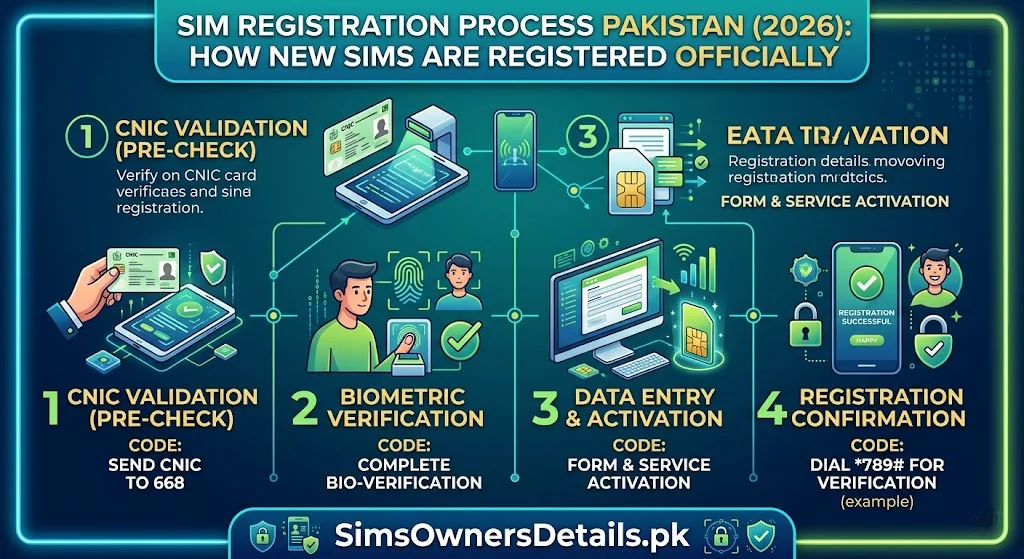
SIM Registration Process Pakistan 2026 — How New SIMs Are Registered Officially
Every Pakistani mobile subscriber interacts with Pakistan’s SIM registration system — but very few understand exactly how the process works
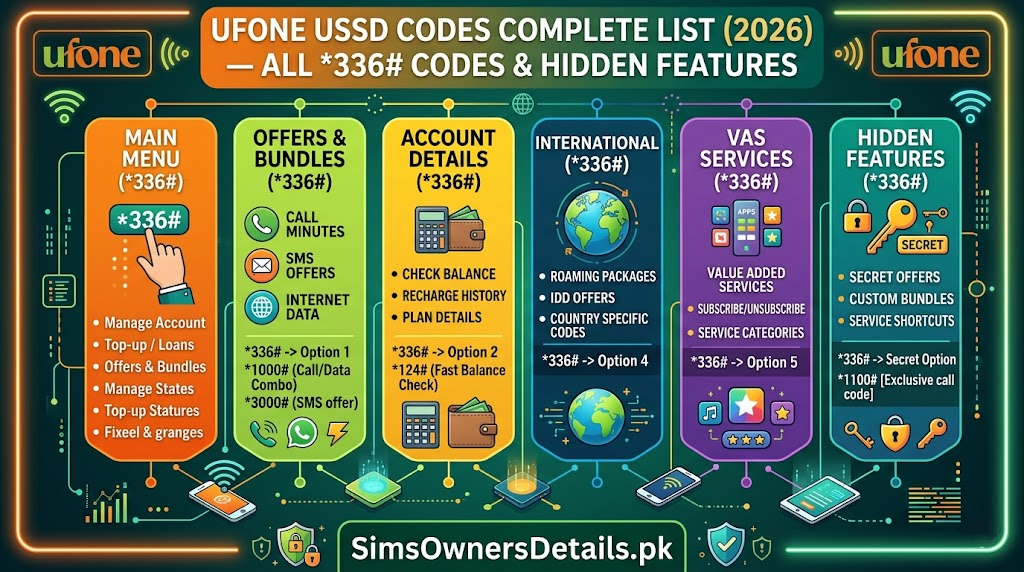
Ufone USSD Codes Complete List 2026 — All *336# Codes and Hidden Features
Ufone is Pakistan’s fourth-largest mobile network — owned by PTCL (Pakistan Telecommunication Company Limited) and serving over 22 million subscribers,
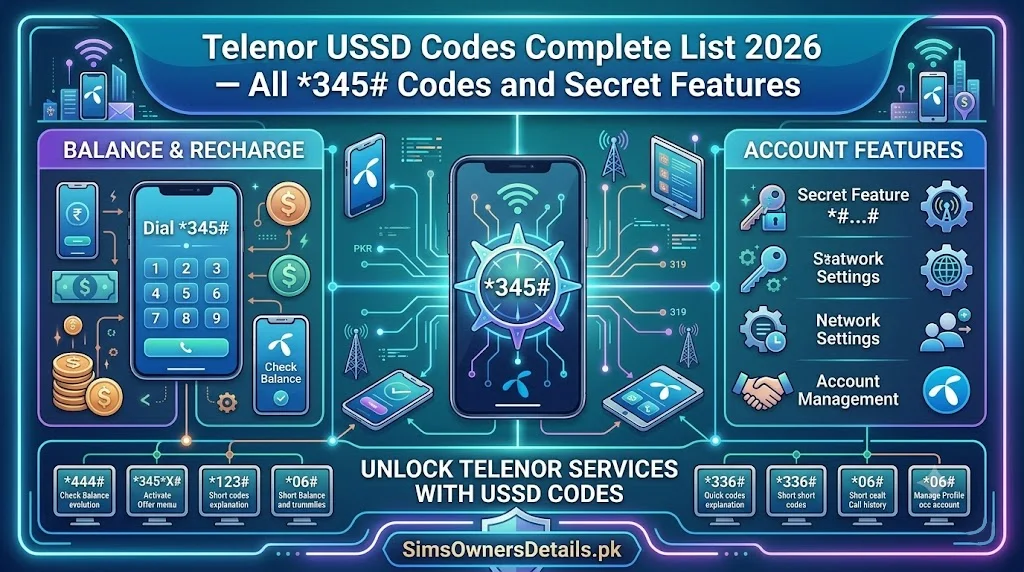
Telenor USSD Codes Complete List 2026 — All *345# Codes and Secret Features
Telenor Pakistan is the third-largest mobile network in the country, with over 45 million subscribers and one of the most
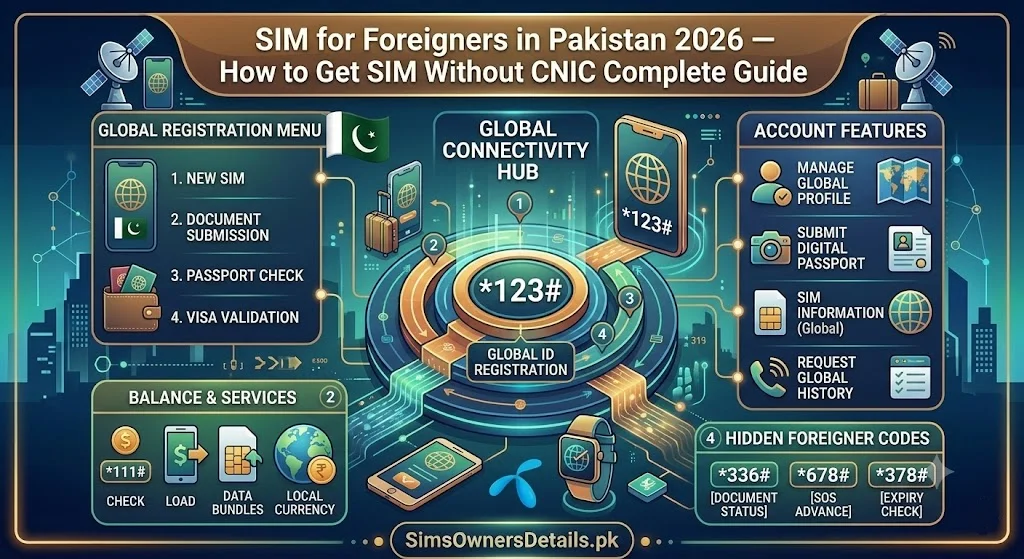
SIM for Foreigners in Pakistan 2026 — How to Get SIM Without CNIC Complete Guide
Pakistan hosts millions of foreign visitors annually — tourists, business travelers, diplomats, foreign workers, students, and aid organization staff. Every
NADRA Services Complete Guide Pakistan 2026 — All Online and Offline Services
NADRA (National Database and Registration Authority) is the most important government agency in the daily life of every Pakistani citizen.
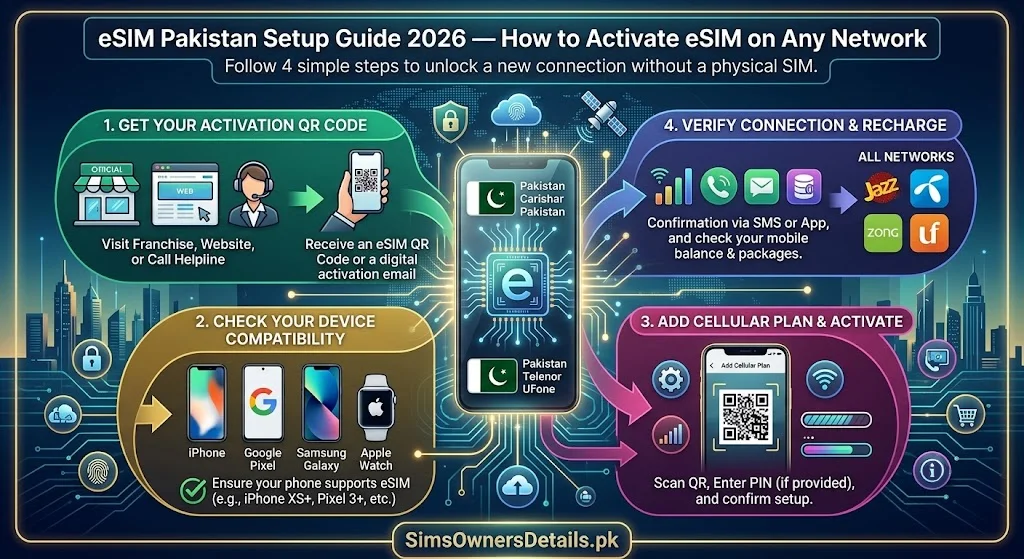
eSIM Pakistan Setup Guide 2026 — How to Activate eSIM on Any Network
eSIM technology has arrived in Pakistan — and with all four major operators now offering eSIM services, Pakistani mobile users
Sim Owner Details — Complete FAQ
Every question about checking SIM owner details in Pakistan — officially answered.
3 official options:
📱 668 SMS — fastest, about Rs. 2
🌐 cnic.sims.pk — free, printable record
💬 PTA Digital Assistant (WhatsApp) 0315-0055055 — free, works from abroad
667 (send "MNP") checks the one SIM physically in your hand and confirms its registration and network with a masked CNIC — use it to verify a specific SIM before trusting it.
❌ False: "5 per network" (implying 25+ total)
❌ False: "Reduced to 6" — no official PTA notice supports this
668 does NOT show: Your full name, complete CNIC, or home address.
For your full registered name and a printable record → use cnic.sims.pk.
Does NOT return: your name, full CNIC, or any other person's details. It is a verification code, not an owner-name lookup.
✅ Free · ✅ No login or app install · ✅ Result can be printed or saved
💬 PTA Digital Assistant — 0315-0055055 — message on WhatsApp, follow the menu. Free, 24/7.
Note: disowning a SIM still needs an in-person biometric visit. To disown a SIM from abroad, authorise a trusted family member in Pakistan with a notarised authority letter and a copy of your CNIC.
Still nothing? Try cnic.sims.pk or the PTA Digital Assistant (0315-0055055).
Steps: Save 0315-0055055 → open WhatsApp → send any message → select from the menu (SIM check / device IMEI check / complaint).
✅ Works from any country · ✅ Free · ✅ No Pakistani SIM needed
Source: pta.gov.pk official release, February 25, 2026
✅ Works from any country · ✅ CNIC and NICOP holders · ✅ Free
Source: ProPakistani, May 25, 2026
Source: ProPakistani, May 19, 2026
🟡 Rs. 200 maximum — for voluntary disowning, capped by PTA from January 1, 2024. Operators cannot legally charge more.
Warning sign: your phone suddenly shows "No Network."
Best prevention: a monthly 668 check plus app-based 2FA instead of SMS codes.
2️⃣ Call the helpline: Jazz 111 · Zong 310 · Telenor 345 · Ufone 333
3️⃣ Visit the franchise with your original CNIC for biometric disowning
4️⃣ File a complaint at complaint.pta.gov.pk
5️⃣ Report to the NCCIA cybercrime helpline if fraud occurred
6️⃣ Secure any linked bank/wallet accounts
✅ Enable real-time transaction notifications
✅ Use authenticator-app 2FA where available — cannot be intercepted via SIM swap
✅ Never share OTPs over phone calls
🌐 NCCIA (National Cyber Crime Investigation Agency) — for fraud, harassment, identity theft; confirm the current complaint channel on the government's official site
📞 Network Helpline — for emergency SIM block
❌ Checking someone else's — criminal offense under PECA 2016 Section 16: up to 3 years imprisonment and Rs. 5 million fine.
Section 3: Unauthorized system access → 3 months / Rs. 50,000
Section 4: Unauthorized data copying → 6 months / Rs. 100,000
Section 16: Unauthorized identity information use → 3 years / Rs. 5 million — the section most relevant to sim owner details
Section 17: Unauthorized SIM issuance → 3 years / Rs. 500,000
✅ NCCIA / law enforcement — with a valid investigation or court order
✅ Network operators — for their own subscribers only
❌ No employer, landlord, journalist, spouse, or private individual has this authority.
To transfer a deceased relative's SIM: the legal heir presents the death certificate, the deceased's CNIC, their own CNIC, and a NADRA Family Registration Certificate (FRC) at the franchise, then cancels the CNIC separately at NADRA.
Source: ProPakistani, January 2, 2026
No matching questions found. Try a different keyword.
Start Your Sim Owner Details Check Now
60 seconds · Rs. 0–2 · No app download needed
 SIM OWNER DETAILS